The leapfrog method is a method that enables us to calculate a wave in motion over time. It does this by calculating the wave equations real and imaginary components in sequential order then adding the results to form the wave over time.
using Plots
include("Real.jl")
include("Imag.jl")
function leapfrog()
   ENV["PLOTS_TEST"] = "true"
   ENV["GKSwstype"] = "100"
   N = 1000
   x = collect(0:(1/(N-1)):1)
   x_0 = fill(0.4, N)
   C = fill(10.0, N)
   σ_sqrd = fill(1e-3, N)
   k_0 = 500.0
   Δ_x = 1e-3
   Δ_t = 5e-8
   ψ = C.*exp.((-(x-x_0).^2)./σ_sqrd).*exp.((k_0*x)*1im)
   R_cur = real(ψ)
   I_cur = imag(ψ)
   V = fill(0.0, N)
   for i = 600:N
      V[i] = -1e6
   end
   I_next = imag_psi(N, I_cur, R_cur, Δ_t, Δ_x, V)
   # Do the leapfrog
   anim = @animate for time_step = 1:15000
      #global R_cur, I_cur
      R_next = real_psi(N, R_cur, I_cur, Δ_t, Δ_x, V)
      R_cur = R_next
      I_next = imag_psi(N, I_cur, R_cur, Δ_t, Δ_x, V)
      prob_density = R_cur.^2+I_next.*I_cur
      I_cur = I_next
      plot(x, prob_density,
      title = "Reflection from cliff",
      xlabel = "x",
      ylabel = "Probability density",
      ylims = (0,200),
      legend = false,
      show = false
      )
      plot!(x,abs.(V))
   end every 10
   gif(anim, "./Figures/ExtraLeapFrogCliff.gif", fps=30)
   return 0
end

@time leapfrog()
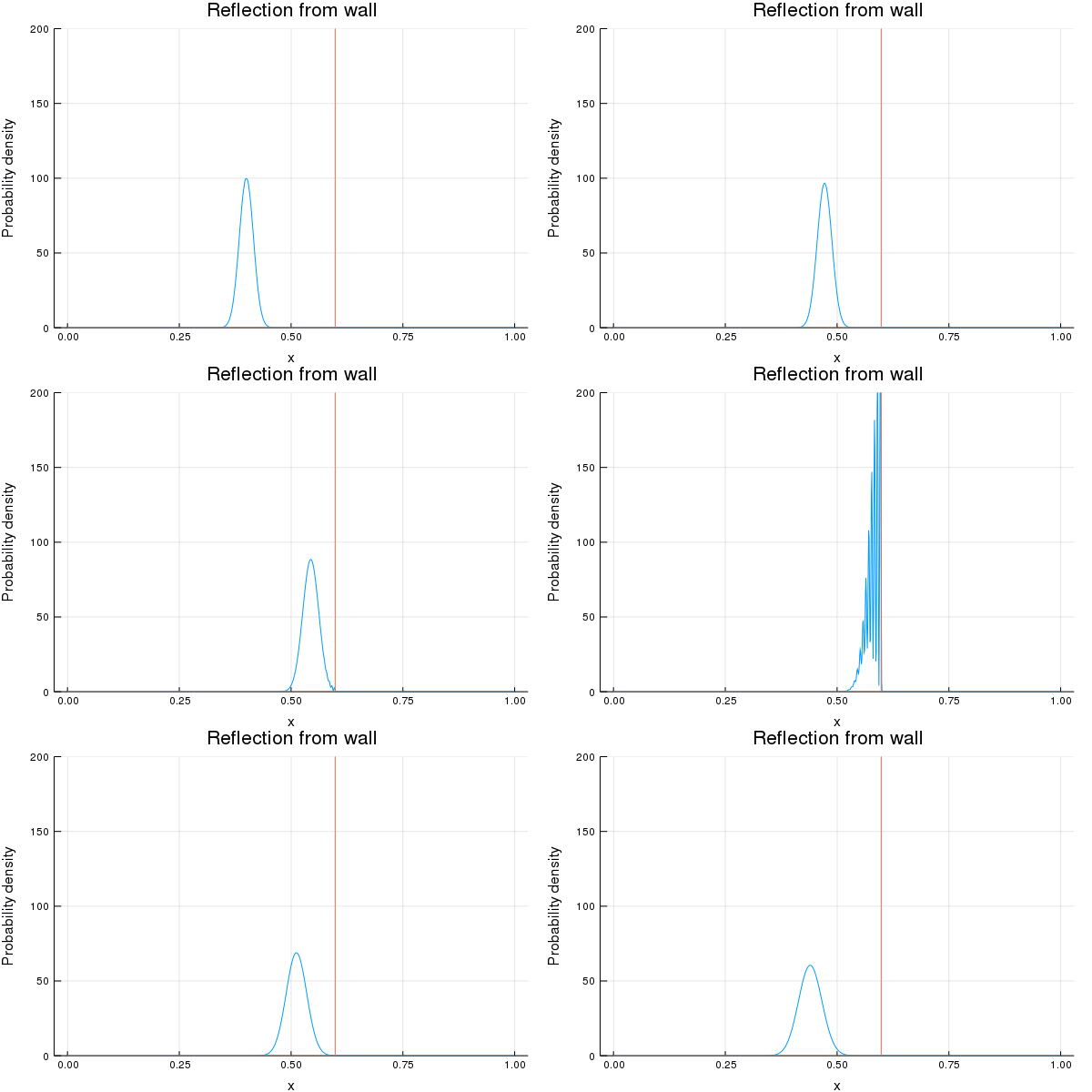
This code can be used to produce the affect of a wave hitting a wall and a cliff or any other barrier/obstacle. The following two graphs are the results of the wave hitting a wall and a cliff.


 Beowulf Cluster